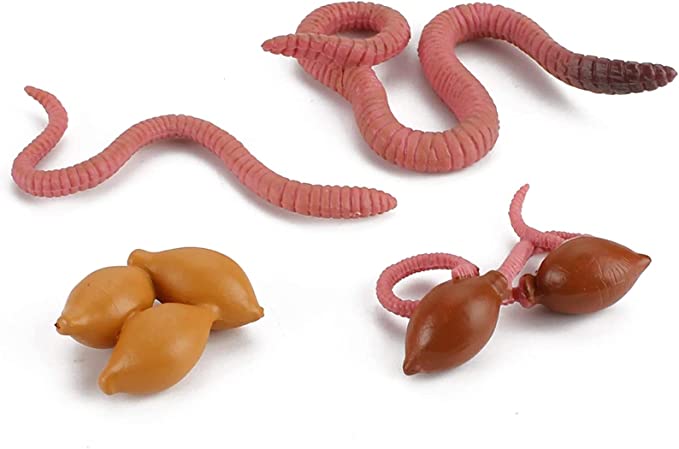
Earthworms have been around for a very long time. An earthworm does not have a skeleton. It has bristles on each segment called setae (see-tee) that help the earthworm move.
Earthworms have no limbs but the setae are almost like little legs that help it slide through the soil. There are four pairs of setae in each segment of a worm’s body. The earthworm has two sets of muscles: one that makes it long and thin and one that makes it fat.
An earthworm has a nervous system with a simple brain and nerve cord. Some earthworms (night crawlers) can live up to 5-10 years! This is probably because they can’t be attacked and eaten by birds since they are so deep below the surface (unlike the common red earthworm).
Types of Earthworm:
- Red earthworm: this is the most common one you will see in your garden and lives near the surface. These guys can be bred just to recycle garbage!
- Night crawler: This guy is found much deeper down in the soil maybe 6ft below.
There are over 2700 species of earthworms in total!
What is an earthworm made up of?
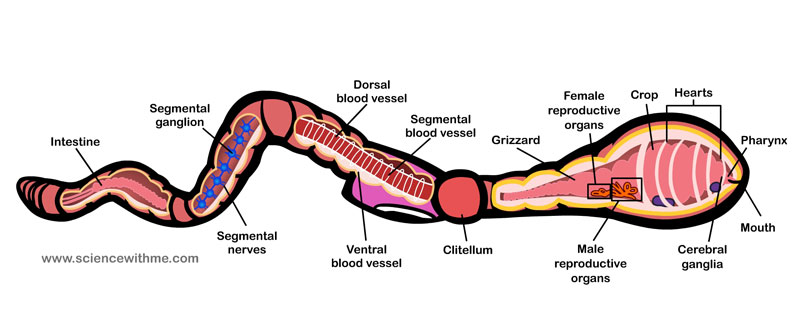
A fully-grown earthworm can have anywhere between 120-170 rings. The first segment is it’s mouth and the last segment is its anus. Earthworms range in length from 1-2 inches to 8ft! (The 8ft long species comes from Ecuador in South America). Did you know that an earthworm has FIVE hearts! These hearts pump blood (containing oxygen and nutrients from the food that the worm eats) throughout its body to all its different parts. Earthworms are hermaphrodites. This means they have two private parts. One part is a boy part and the other part is a girl bit. However, the eggs must be fertilized by another worm. An earthworm lays a batch of eggs at one time. They do not spend time raising their young once they are hatched.
What and how does and earthworm eat?
It eats dirt, digesting the plant and animal matter in the soil and then eliminates the rest. An earthworm’s waste helps to fertilize the soil. It gets rid of its wastes through tubes called nephridin that lead to pores that allow the waste out. It has an esophagus for the food to go down, a crop to store the food in, a powerful muscle system called the gizzard which grinds the food down, intestines for the food to pass through and take out nutrients and an anus for the food to come out.
How does can earthworm breathe?
An earthworm has no respiratory organs. It takes in oxygen directly through its skin and gives off carbon dioxide. Its skin is always moist.
Why are earthworms so important to mother nature?
They are very important because they spend most of their time digging around in dirt, eating leaf bits and the remains of dead animals. As they do they accomplish three things:
- Their eating actions serve to turn the soil.
- The tunnels they produce as they move through the soil “aerate” that soil, meaning that they allow it to take in valuable air that it would not otherwise receive.
- Worm castings (aka: poop) provide recycled nutrients to nourish the soil.
These three actions actually make the soil more fertile! Worms, just by doing their wormy things – eating and pooping – change over the soil that you see in your garden, at a farm or wherever soil needs to be moved. This conversion process can actually reach depths of about 6ft into the ground but is not accomplished by one type of earthworm alone.
Interesting Worm Facts:
- Cleopatra, the Egyptian queen, believed worms were sacred. We, at Science With Me! tend to agree with her! Earthworms are fantastic!
- If a worm is cut into two parts, the part with the head segment will live on and grow a new tail. However, the tail portion will not regenerate a new head and will eventually die.
- The next time you see a worm don’t say; “eeeeewwww”….just say “Earthworms are amazing!”
Want to learn more about Earthworms? Check out our An Introduction to the Earthworm Collection. Interested in animals in general? Continue to learn about them by downloading our fun Introduction to Animals E-Book. It’s a great learning aid for children interested in science and the wonderful world we inhabit with many fellow creatures.